11/30/2012

Three Kinds of Women’s Discourses in Modern China -- Brief Report on Prof.Qu Yajun’s Lectures in Japan: Part 1


Qu Yajun is a professor at Shaanxi Normal University, Xian, China, and director of both the Women’s Research Center and Women Culture Museum of the university. Despite the fact that the Japan-China relationship was in danger of being jeopardized by the Senkaku (Diaoyu) Islands dispute, with even cultural exchanges suspended in many cases, she visited Tokyo as originally scheduled to speak about women’s studies and her experiences in China.
Prof.Qu’s lectures were both impressive as well as timely, all the more because they were given in the midst of the difficult time between the two countries. What follows is a report on her presentation made at the meeting of the Women’s Studies Association of Japan, on Saturday, November 10, 2012, at Rissho University, entitled “Three Kinds of Women’s Discourses in Modern China.”

Based on what I (the writer of this report) understood from Prof.Qu’s speech, I will describe the major points of the two days of lectures in two consecutive reports, of which this is Part 1, and will also add my personal comments inspired by her lectures.  


(1) “Half the Sky” Discourse


Back in the Cold War period, socialist countries were often depicted as dreams come true. China was also highly regarded at the time in terms of women’s status in society as evidenced by the quotation of Mao Zedong,“women hold up half the sky.”

According to Prof.Qu, these words of Mao suggested that women are as capable as men. As a result of the Chinese Revolution, the traditional idea of “men outside, women inside” was overthrown, replaced by the ideal of independence, liberation and equality of men and women. The major promoter of the “half the sky” discourse was the All China Women’s Federation (hereinafter ACWF), formed in March 1949, even before Chairman Mao’s declaration of the People’s Republic of China.

According to Prof.Qu, however, the widely accepted notion of women being equal to men could be misinterpreted as women acting like men. Since the “half the sky” is a mainstream discourse, it carries ideological dogmatism and authoritarianism with it. As it regards self-pride, self-confidence, self-independence and self-empowerment as its standards, the discourse tends to leave women unaware of their actually weak position in a still patriarchal society.

After the 1980s, Prof. Qu points out, the above-mentioned four “self”s were no longer so obviously praised in novels but the “half the sky” discourse was represented by brave women soldiers, excellent women judges and successful businesswomen instead.


(2) “Feminist” Discourse

In the same period, Prof. Qu reminded us, China started to be influenced by Western feminism. Especially after the fourth UN Conference on Women held in Beijing in 1995, awareness of feminism was enhanced and attention to the socially weak, including women, increased. There began a move to deconstruct masculine culture and to interpret sex and gender as a political discourse.

Compared to the “half the sky” discourse, this new “feminism” was characterized more as an attempt by women for women to emancipate themselves. Instead of being on the receiving end of social liberation, feminist women now began to fight their way into their specialized research areas from a gender-oriented perspective, eschewing mainstream ideology.

According to Prof. Qu, more than one hundred research institutes have been established in China, carrying the term “gender,” “feminism” or “women,” serving to raise the status of women’s studies in higher education. On the other hand, her concern is that they tend to be plagued by staff shortages, budget problems and a lack of facilities. Furthermore, Prof. Qu goes on to say, post-modern philosophy, which represents the core of feminist theory, is too difficult for ordinary people to understand. Therefore, in her view, feminist oriented studies, in their efforts to counter male-centrism, could cause anew a center-peripheral conflict between woman and woman.

Nonetheless, Prof.Qu observes that the “half the sky” and “feminist” discourses tend to merge with each other. The facilitating factors include deepened understanding between the chief staff of relevant departments of ACWF and women scholars through joint efforts in various activities. As reform and open policy accelerates, the boundary between women staff from the proletarian class and women scholars from intellectual families have also been removed.


(3) Emergence of “Modern Ladies” and Coexistence of the 3 Confronting DiscourseS?


Against the above-mentioned two kinds of women in modern China, quite a new category called “modern ladies” emerged. Prof. Qu introduced them as the kind of white collar woman one finds on the cover of fashion magazines or the beautiful women serving as TV newscasters.

They know that they cannot expect to enjoy any more protective measures as women in severe competition in a market economy. They disagree with the “half the sky” discourse as it is so old-fashioned and criticize the “feminist” discourse as it is too radical. Prof. Qu is critical of the “modern ladies” discourse because it has internalized men’s view of masculine culture, as women’s beauty, elegance, gentleness and weakness are being commercialized.

Prof. Qu does not see the boundary between the “modern ladies” and “feminist” discourses as clear and fixed. She maintains that those concepts like “personal” and “private” from Western feminism are also characteristic of the “modern ladies". But the “modern ladies” discourse was generated and developed along with the market, which is the mainstream ideology in present-day China. So it contradicts with the “feminist” discourse which is characterized by its attention to the periphery. No matter how apparently the “modern ladies” try to come off as appearing advanced in the business world, they inevitably end up being objectified and alienated in men’s eyes.

There was a question raised by the audience as to how the “housewives” are positioned within those discourses, but unfortunately Prof. Qu did not have time to elaborate on this issue.

A few weeks later, I had a chance to meet a Chinese friend, a young woman working at a publishing company in Beijing. In response to my question, she presented her personal view, saying that those “modern ladies” seek to meet one of those “new rich” men who were also the product of the market economy, and become a housewife. Unlike activists or scholars, the ordinary women seem to be strongly affected by the “modern ladies” discourse.

At the end of this lecture, Prof. Qu summarized the relationship between the coexisting three discourses about women as follows:

All three are double-sided in their own way, complicating their relationship. The government authorized “half the sky” discourse certainly freed Chinese women of some burdens western women must have tackled. It could control the negative results of commercialism through its orthodoxy. And yet, its orthodoxy could become conservatism, resulting in conflict with the radical “feminism” discourse. The “feminism” discourse, which could be a powerful weapon to fight back against masculine ideology, might come to a dead end if it recklessly crashes with the “half the sky” discourse, ignoring cultural and social characteristics of Chinese society and practices. The “modern ladies” discourse is attractive because of its newness and trendiness, but might become retrogressive as the society itself advances.


~~To be continued in Part 2~~
Reported by FUKUOKA A.A

Japanese version was also written by FUKUOKA A.A. 


11/28/2012

Nuclear Free Now!

Women's Action Network is proud to announce its involvement in Nuclear Free Now!, a series of international, participatory events that will be held simultaneously in Tokyo and Fukushima on December 15-16, 2012. Please follow this link for details. 

WAN and Greenpeace Japan will co-host a symposium on women, politics and nuclear power on December 15. Details will be posted on the NFN site. 


Posted by Aya Kitamura


11/10/2012

Eulogies to Kazuko Takemura (8): Carmen Rial


To honor the memory of the late Kazuko Takemura, a feminist famous for her activism as well as introducing theorists such as Judith Butler, Slavoj Zizek, Gayatri Chaktravorty Spivak and Trinh T. Minh-ha to Japan, WAN is posting a series of eulogies delivered by her fellow activists and scholars both from Japan and overseas.


Carmen Rial
The professor, The Department of Anthoropology, Federal University of Santa Catarina


I have learned about the passing of my colleague and friend Kazuko Takemura through a note of Paola Bachetta (Berkeley University), posted on the internet. Paola wrote:
"Kazuko Takemura R.I.P. She left this earth on December 13, 2011. Brilliant feminist queer scholar, theorist, and translator. A path breaker in Tokyo and the world.A wonderful generous human being. We will miss her at Berkeley where we had the pleasure of directly engaging with her work while she was in residence for a year. We have missed her in my neighborhood where she and Kiyomi were my next door neighbors during that year. Kazuko's passing is a terrible loss to many people whose lives she touched with her scholarship and life.”

Appropriate words that describe Kazuko as academic and as very "generous human being." That has been my impression since I have first met her, in 2009, on the day of our arrival in Berkeley. It was scheduled a meeting of researchers at the Beatrice Bain Research Group (BBRG). We only had time to leave the bags in the house and run down Euclid Street to the Barrows Hall.

It’s probably that most of the colleagues with whom we shared coffees and good discussions in that year were there: Jacqueline Adams, Laura Fantone, ElkeHeckner, Lois Hembold, Michele Pridmore-Brown, Xiaohui Zhu, Mary Curran. But I only remember Maria Luisa Femenias, an Argentine philosopher, that I have already known, and Kazuko Takemura. Why Kazuko? Not for anything she said during the meeting. Rather because, in a gesture of gentle hospitality, she shows us the campus, taking  with her bike in one hand and a yellow helmet on the other. We went to see the Sproul Hall, the historic site of the first demonstrations of May 1968. "Here, Barack Obama spoke" she said, as she passed by to get a ticket for a play at the box office in front. We have sympathized immediately. It was the beginning of a brief and intense intellectual exchange and friendship.

In the weeks that followed, we often have been together. At Paola’s home for a dinner, at the BBRC lectures, or for car rides. On March 21th, 2009, I remember, I wrote in mydiary: “I discovered a book by Trinh T. Minh-ha on the shelf here at home, with an interview with her by Kazuko Takemura. It was a long interview, which explored various aspects of the work of Minh-ha.” Thisgave us the idea to suggest Minh-ha as a keynote at the Congress Fazendo Genero (Making Gender) in Florianópolis.
On April 28th, Kazuko gave a lecture at Barrows Hall. She was introduced by Thrin Min-ha, with a long and poetic opening that showed her respect for the academic work and friendship she had for Kazuko. The lecture was called Violence-Invested (non) Desire: Global Biopolitics Phallomorphism& Lethal. She sent us a copy:

    “Let me start with the title of my speech. First, I planned to call it "Is Violence Still Masculine?".  This interrogative style expects an answer, "yes" or "no," in a dichotomous way based upon sexual difference.  But I wanted to stay away, for a while, from the issue of sexual difference and examine that sort of violence which is seemingly confusing sexual hierarchy. Specifically, the reported photos of Abu Ghraib prison gave me a great shock, in which women soldiers abused male Iraqi detainees, physically and mentally. This is the reverse of the familiar schema of violence: male perpetrators vs female victims.
    Why are we shocked by these photos? Does violence practiced by women invalidate feminist claims against the brutality of patriarchy? What impetus drives the women soldiers to perpetrate such acts? Is sexual desire related to them? Or other kinds of desire, if there are? Or, is desire itself engaged in this abuse?  If not, what else drove them into such atrocities?
    I’m going to think about these matters today, under the title of “Violence-Invested (non-) Desire.” Its subtitle, “Global Phallomorphism & Lethal Biopolitics,” intends to show my aim of reconsidering the relationship between sexual difference and what could be called a new (emerging) deployment of violence”

We will always remember Kazuko as a clever feminist, a critique of contemporary world events. Moreover she is also a friend, open for an invitation for coffee or for some adventure. With Kazuko, we have visited the Stanford campus, traveling by train and being guided by Michelle. We have also been at the Santa Cruz campus, to attend a lecture by Gail Rubin on the anti anti-pornography theme that particularly interested her. Kazuko showed me the way for the beautiful n.1 road that host Pacific coast’s winds. With good humor, we shared jokes about the fact that we were going to meet a real dinosaur of American feminism. And by our astonishment, Rubin appeared, in a perfect self-irony, wearing a tie with drawings of dinosaurs!

Kazuko counted the days to the Kiyomi’s arrival, and as soon as she got in Berkeley she invited us to dinner at a Louisiana restaurant. I found them again months later, at the airport of Florianopolis, in southern Brazil, where he was attending an invitation from Congress Fazendo Genero, to participate in a roundtable. Kazuko and Kiyomi got off the plane with broad smiles and colorful summer shirts, purchased during their tour of South America. I was waiting beside Trinh-Min Ha, who had accepted to be the keynote at our conference, thanks to the encouragement of Kazuko and Paola.
Kazuko's speech, "Diaspora, Sexuality and Becoming Something Non-Existent", in the main auditorium of the Santa Catarina Federal University was excellent. It was published in Portuguese in the book Fronterias de Genero (Boundaries of Gender (ed. Mulheres, 2010).

Our last email exchange occurred soon after the Tsunami. Kazuko wrote me:

Sun, 13 Mar 2011 11:21:28 +0900
Hi Carmen,

Thank you so much for your kind concern.  Kiyomi and I are both OK, and my friends and students from the northern part of Japan as well as their families are fine, I have heard.  But so many people are killed and injured, and still missing.  The earthquake and tsunami, which occurred in tandem on Friday, was so devastating and ferocious, and we still--even here in Tokyo--feel afterquake many times. Moreover, a dander of meltdown at two of the atomic plants is now worried about.

As for me, I am now hospitalized for a removal of fibroid.  Don't worry. I am OK.  The main aftermath of the earthquake is for me that it might cause a delay of my surgery, which is to be scheduled for tomorrow, March 14th.  But, if so, the operation will be made on Thursday, at latest, the doctor said.  It might not be so good timing for undergoing surgery.

I hope that sufferers and victims are rescued, medicated, and supported as soon as possible and in a full scale, and also that such an awful thing as a meltdown never ever happen!!

I'll keep you posted.


Posted by Aya Kitamura

11/06/2012

The Choice of A Woman (2) - Starting a jobless life In case of Ms. T -

I spent a long time of my career in an organization. After I left the municipal office due to the mandatory retirement, I chose to be jobless. Reaching the age of 60, male co-workers, who retired at the same time with me, moved on to the second career.

Perhaps, those male co-workers decided to be re-employed for economic reasons, but in my case, it seems I could manage to make my ends meet with my own pension and one from my husband who had retired earlier.
I could have chosen to be re-employed as well, but it does not mean I could work forever. I have no idea how many more years are left for me, but I want to re-build my life while I am still strong physically and spiritually. By doing so, more than anything, I want to set free myself who have been held back during the long career in the organization. Feeling slightly superior to those men who still need to work, I chose a jobless life without thinking twice.
It is riskier and harder than you imagine for a woman to survive in an organization.
The first workplace in the municipal office I was placed 38 years ago was a division with just over 10 people who were all male but me. The work included on-site tasks, so sometimes I found myself alone in the office to take phone calls. When I answered the phone, the caller usually said, “So everyone is out…” Being a woman, I was not counted as a staff.
Things changed and female workers are now a big part of the organization. But still, male workers are the main stream in terms of participating in various decisions as the management. It is still a male-dominated society, unfortunately. It was usually the case that I was the only female or one of a few females out of over 10 participants in a meeting.
“An organization and a male-dominated society” – I wanted to leave there and return to be just me after 38 years. My jobless life started from there.
There is no doubt that my days changed drastically starting April.
I used to leave home at 7:30 in the morning and returned home at 6 in the evening. Now I have that much time all for myself. It is so much time that it is amazing. While I was employed, I had meetings to attend, documents to sign, references to read, subordinates to manage…there were piles of things I needed to do.
Starting April, only limited tasks are assigned to me. Laundry and cleaning have been my husband’s jobs since when we were both working. Having become jobless before me and already managed to set own rhythm, my husband did not want me to change his way of life. He prepares breakfast and lunch by himself. So all I need to do now is to prepare breakfast for my son who goes to work, prepare dinner for three of us and look after our cat. What an easy life! It does not require 1 percent of the power I used to use. It is so easy that it makes me feel bored.
As I kept myself busy with work and home, I have lost interest in the other things. I used to love books as a little girl, but I hardly read these days. I have minimized my social life with neighbours and relatives also.
Since my daily tasks in the post-retirement life are so simple with preparing meals and looking after a cat, I felt awakened to a question, “Am I really up just to this?”
I said to myself, though, “Let’s start from here.” Let’s not accept a task or role against my will; I have made all the way to the age of 60; I managed to work until the mandatory retirement and left work without regret. I made up my mind to spend my remaining days focused.   
Then, the first thing I worked on is to build a nest.
The municipal office building I used to work was like my own nest. The moment I left home, I reviewed the agenda of the day in my head and the moment I sat at my desk, I was already working. I continued the daily routine for 38 years and spent most of my life at the building. But it has become distant quickly once I retired.
The workers welcome me in a warm manner as I visit them after retirement. But of course, the work goes on without me and there is no longer a place for me, either.  
  
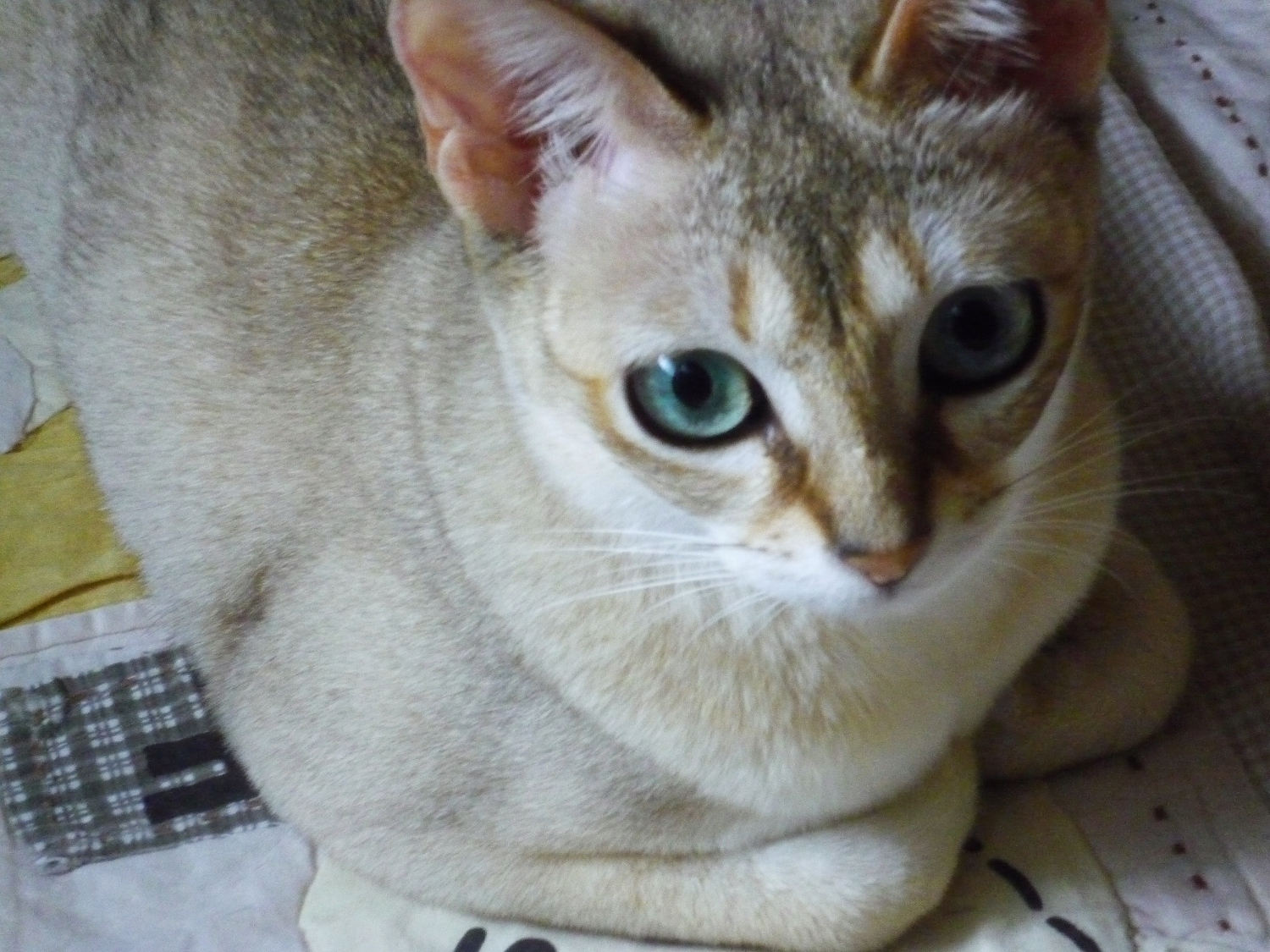
A one-year-old Singapura joined the family last year
I started building a nest in our house. Built 100 years ago, the house is old and large with enough number of rooms but there was no room only for me. I never needed one because I had never had time to relax in my own room. I cleaned a storage room in the size of 6 tatami mats and created a space just for myself equipped with a desk, a bookshelf, a PC and a TV.
I sit here comfortably and welcome the start of my second life, as my faithful cat with wistful eyes keeps company.

Original Article on the WAN Website dated Oct. 25, 2012: http://wan.or.jp/reading/?p=8037
Translated and Adapted by K.M.

11/02/2012

Procedure, terms and conditions for free online counseling in English for women living in Japan


If you need counseling about your problem, you can send in an email describing your problem to: counseling@wan.or.jp and write in “Counseling” in the subject slot.
In order to receive appropriate advice, please follow the procedures listed below and agree to the terms and conditions which are essential for this service to function.

1) Write your nickname, place of residence, age and occupation.
I.e. Kyoko (Tokyo, 25 years old, company employee)

2) Please keep the text within 450 words (approx. 1 page of A4 size).
Note: Before we put up your text on our website, we may have to change certain expression if we find it inappropriate and/or unsuitable, but the content will not be altered extensively.

3) The condition for providing our free counseling is that it is done only online and not to respond individually.
4) If the counselor receives more cases than she can handle, please understand that the selection will be made by the topic of problem which pertains to other women seeking similar advice.

5) You will neither be notified whether the problem you submitted will be selected for online counseling or not nor the date it will appear on our website if it is so selected.
We regret not being able to respond to everyone’s problems as well as responding immediately.

Hopefully you will understand our intension and limitation of online counseling service.
It is also our wish that through this service, many women can share the problem introduced and empathize with the woman seeking advice.

10/31/2012

You Can See Yamato from Okinawa (Go Where Our Heart Takes Us: #32)

By Mine Yagi 9/20/12 (Thursday)
Okinawa Times: Dated 9/9 article on the Rally


This year, marking the 40th year since Okinawa’s return to Japan, a rally was held on September 9th to oppose the deployment of Osprey.
Participants exceeded 100,000. The Mayor of Naha (Takeshi Onaga) strongly criticized the action taken by the Japanese and the U.S. government by saying, “the way this deployment is handled is no different from that after the war when they took over our land forcibly with a bulldozer and a bayonet.”

In 1952, in exchange for the San Francisco Peace Treaty, Yamato (the mainlands of Japan) submitted Okinawa under the U.S. military administration, truncating the southern islands.

Since then, the movement to reinstate the islands to Yamato had been tenaciously exercised by Uchinanchu. (The people of Okinawa refer to themselves as Uchinanchu)
Before and after the reinstatement of Okinawa, a freelance reporter and a critic, RoTakenaka, visited Okinawa countless times and predicted that “after being returned to the mainland, this island will be turned into tourism and the pure culture of Okinawa will be lost.” (May Your Strength be your Weapon! The Republic of Ryukyu)

After reinstating the islands on May 15, 1972, Yamato not only forced Okinawa to accommodate 75% of the U.S. military bases in Japan but relocation of Kadena Air Base to Henoko, as well as installation of helipad at Higashimura Takae, devastating the minds and lives of the people of Okinawa.
Furthermore, end of last year, with regards to the environmental effect assessment involving the Henoko relocation issue; to the question put forward by a press, “When will the written evaluation be submitted?”, Satoshi Tanaka, Chief Defense Facility Officer responded, “Who would say, ‘I am going to commit a rape’ before actually doing so?” He shocked everyone who heard this response, and of course, he was dismissed from his position a couple of days later for making such an abusive statement.

You can see Yamato from Okinawa
Anger held deep within the heart, Uchinanchu are keenly watching the future of this country: - the strengthening of military reorganization by Japan and the US governments with the movement of the Senkaku Islands in the background.

As stated in the First Book of Samuel’s Old Testament, “Those with the sword shall be perished by the sword,” is a common gumption in history.
Ryukyu Kingdom was engaged in “Tribute/Sealed book” trade once with China without using a weapon and had a rich distribution network in Southeast Asia. For example, a specialty of Okinawa, awamori (alcoholic beverage) is made by distilling fermented rice from Thailand, a delicious alcohol that was born from the ancient interaction with the Siamese. Yes, the sea has no border.

Okinawa is a Mystic Island
I found A Life of Okinawans (Tenkuu Planning Edition, Chie-no-mori Books, Kobunsha) at Teramachi Sangetsu bookstore in Kyoto. (Oh, I just noticed that Chizuko Ueno has an article in it.)

“Okinawa culture isn’t about this or that, but it’s a “chanpuru” (mixture) of this and that which was taken in from across the sea.”
Although Kachashii dance unite people together as a group dance, “chanpuru” blends people to make one unity but leaving distinct personality and individuality. That’s where the diversity of Okinawa lies.

The book begins with a statement, “There are 2 entrances to Okinawa, front door and a back door.”
I met an Okinawan woman who gave me a tour of both the front and back doors of Okinawa. But three years ago, she left for Niraikanai, the other side of the sea of ​​Okinawa without waiting for her 50th birthday.

By her guidance, we went straight up north for a tasting of awamori with 43-degree alcohol content at the brewery of “Helios Distillery” in Yanbaru. Then we headed down the Route 58 along the west coast to watch the sunset from Cape Manza. In the evening, we arrived at the Nanban Pottery made only with special soil and fire of Okinawa. For three days and three nights, the orange color of 1200° fire continued to burn. It was precious moments spent wrapped in scattered outbursts of cicadas and chirping sounds of birds from the mountains.
Next stop was Okinawa national Hansen's disease sanatorium, “Okinawa Ai Rakuen” located in Nago City on Yagaji Island, floating in Hanejinai Sea. It was surrounded in obscurity quietness. There had not been a bridge to get across to the island before.

We then headed southbound and found a café where we entered in bare feet after walking on the beach. We were told the house next door belonged to Amon Miyamoto, a famous Japanese stage producer/director.
While the woman who guided me and I drank coffee, we got into a subject about a train I had taken often.

“I often used to ride the express-sleeper-diesel train named ‘Naha’ from Osaka to West Kagoshima and wondered why it was called ‘Naha’ since the final destination was Kagoshima and not Okinawa. I thought perhaps the train runs above the sea,” I said and her response was, “It’s because in 1968 the former Japanese National Railways named the new train just put into operation as a gesture of support for the reinstatement of Okinawa.”
That train retired after 40 years of its operation in March 2008.

“Ieraishan,” the night-fragrant flower that blooms in the evening at the gates of many Okinawan’s homes always welcomes guests warmly with its sweet fragrance.
As a traveler, when visiting any country, I always remember to be humble to the people of that land while appreciating their thoughtfulness.

Tag, Yagimine
Category: Travel at Leisure
Original article on the WAN website by Mine Yagi (September 20, 2012) 
Translated and adapted by M. Doioka

10/24/2012


One Out of Three Women with Disabilities Experience Sexual Offenses
It was reported that 1 out of 3 women with disabilities had experienced sexual offenses in their workplaces and institutions for disabled. Specialists claim that “special measures to deal with these problems are necessary because these women are taken advantage of for their inability to resist.”
This study was executed from May to November 2011 by a group of women with disabilities, and the result of the study was reported on the 21st of November at the Japan Social Welfare Conference held in Nishinomiya City in Hyogo Prefecture.
Out of the 87 women who responded to the survey, 31 (36%) said they had experienced physical sexual offenses.
One of the women with visual disability said that her boss at work “touched her breast and lower abdomen” while a woman with a physical disability wrote that “a care worker was feeling her breasts during bathing, and when she told her mother and she didn’t believe her, it made her very sad and painful.”
The group that conducted the research analyzed that such incidents are occurring because the women with physical disability cannot strongly resist due to their physical disability and those with learning disabilities face the problem of not being taken seriously for what they say.
Professor Keiko Kanou at Kansai University who conducted the research is making an appeal to “establish counseling services and create measures to deal with these problems now that the research confirms the suffering of disabled women who are target of sexual offenses.”
Translated by M. Doioka from 10/22 dated NHK News submitted to WAN by Midori